- sisdoz@sisdoz.com.tr
- TR

Blog
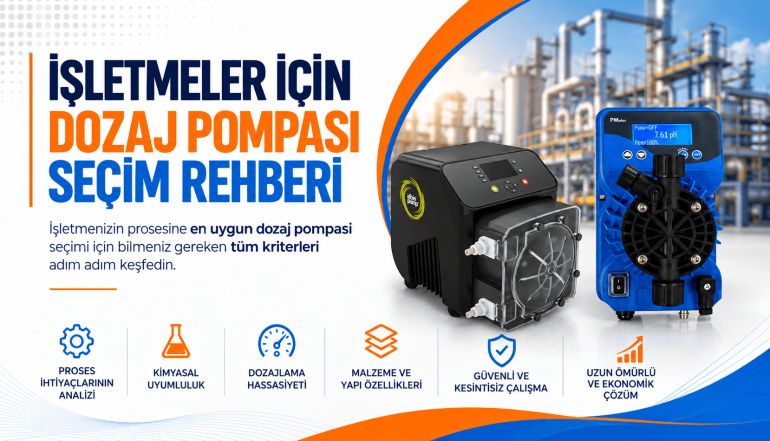
Dosing Pump Selection Guide for Businesses
Selecting a dosing pump for a business involves identifying equipment capable of delivering the required quantity of chemicals at the actual operating pressure and within the desired control range. To achieve this, factors such as chemical compatibility, suction conditions, automation requirements, and maintenance capabilities must be evaluated alongside flow rate and pressure specifications. Basing a purchasing decision solely on catalog capacity can lead to difficulties with adjustments during low-production periods or performance issues during commissioning.
Define the Pump's Function First
The initial question is not merely which product the pump will deliver, but rather what the process aims to achieve through this feed. Adding additives to a constant-speed line, injecting chemicals proportionally into a variable-flow water stream, and controlling pH levels represent distinct operational needs. It is essential to determine upfront whether the feed will be continuous or batch-based, how the pump should behave when production halts, and the extent to which the process might be affected if dosing is interrupted.
This definition prevents allocating budget for unnecessary features while ensuring that required functions are not omitted from the proposal. Relying solely on average daily consumption for selection is insufficient, particularly for businesses where production volumes fluctuate between shifts.
Calculate Minimum and Maximum Flow Rates Separately
It is just as important for the pump to provide controlled dosing under minimum production conditions as it is to meet maximum capacity requirements. For instance, if an oversized pump is selected for a system that operates at low capacity for most of the day, it may become difficult to precisely and stably regulate the small quantities required. The capacity margin should be determined by considering anticipated future growth, the manufacturer's recommended operating range, and the specific process requirements.
In a sample calculation based on the active ingredient, if the process flow rate is 20 m³/h and the target dose is 5 mg/L, the required amount of active ingredient is 100 g/h. If the prepared feed solution contains 100 g of active ingredient per liter, the theoretical solution requirement is calculated as 1 L/h. This example illustrates only the unit conversion; it is not a dosage recommendation for a specific application.
The calculation formula is as follows:
Pump flow rate (L/h) = Process flow rate (m³/h) × Target active ingredient dose (mg/L) ÷ Active ingredient concentration of the solution (g/L)
If the concentration is given as a weight percentage, the solution density must also be used when converting to g/L. Confusing the amount of active ingredient with the amount of commercial product can lead to incorrect pump sizing.
Evaluate the Operating Pressure at the Injection Point
The pump conveys the fluid by overcoming not only the pressure in the process line but also the pressure losses in the discharge line and fittings. Therefore, a single pressure reading taken from a different point in the system may not be sufficient for selection. Normal operating pressure, potential pressure surges, and the characteristics of the connection line must be considered together.
It must be verified via performance data that the proposed model can deliver the required flow rate at this pressure. Back-pressure arrangements for applications with low or fluctuating line pressure, and appropriate protection equipment for installations at risk of overpressure, must be evaluated separately. The function and placement of accessories should be determined based on the specific project requirements.
Check Chemical Compatibility for All Wetted Parts
The durability of the pump head alone is not sufficient. The diaphragm, seals, valve balls, valve seats, tubing, and injection assembly may all be exposed to the same chemical. When selecting materials, the exact chemical name, concentration, and temperature must be specified. The fact that a material is suitable at a low concentration does not imply it is also suitable at a higher concentration.
Viscosity, tendency to outgas, crystallization, and solid particles also influence the selection. Discrepancies between standard catalog test conditions and actual operating conditions may arise, particularly with fluids that are denser or more difficult to pump than water. Confirmation should be obtained based on the manufacturer's chemical resistance data and the application limits of the specific model.
Select the Pump Type Based on Application Requirements
Solenoid-driven diaphragm models can be considered for chemical dosing applications within suitable flow rate and pressure ranges. Motor-driven diaphragm or piston options can accommodate varying capacities, pressures, and operating regimes. Peristaltic designs, with the appropriate choice of tubing, can serve as an alternative for handling certain viscous fluids, fluids containing gas, or fluids with suspended particles. The limitations of each design vary depending on the specific model and fluid conditions.
The goal here is not to declare one specific pump type superior for every facility. The dosing pump option that best meets the facility's needs should be determined by evaluating the operating point, material compatibility, control capabilities, and maintenance requirements in conjunction.
Do Not Overlook the Suction Line When Making a Purchasing Decision
The position of the tank relative to the pump, the length and diameter of the suction line, the number of connections, and the fluid properties all affect the pump's priming and filling. A suction line that is excessively long or narrow can cause problems, particularly with viscous fluids. For chemicals that release gas, the design of the pump head and the air venting arrangement also become critical.
When acquiring a new pump for an existing facility, one should not assume that old hoses and connections can simply be reused. Material compatibility, the condition of the lines, and the necessary ancillary equipment must be re-evaluated. A pump that appears suitable in the catalog may fail to deliver the expected flow rate in the field due to an improper suction line configuration.
Match the Control Method to Process Variability
Manual adjustment may suffice for applications requiring a constant feed rate. Conversely, for lines where the process flow rate fluctuates, proportional dosing based on a flow meter signal may be more appropriate. In pH control applications, chemical demand is not solely dependent on water flow rate; measurement accuracy, mixing time, and control settings also influence the outcome. Therefore, flow-proportional dosing and feedback control based on measured values should not be considered the same function.
For the automation connection, it must be determined whether pulse, 4–20 mA, or communication options will be used. Remote start/stop, tank level monitoring, fault output, and behavior upon signal loss must also be included in the scope of the proposal. Compatibility with the facility's existing control system must be clarified before the device is delivered.
Compare Quotes Based on Total Operating Cost
When comparing the purchase prices of two pumps, it is essential to verify whether the scopes of the quotes are identical. One quote might include the injection assembly, level monitoring, and connection fittings, while another might cover only the pump itself. This discrepancy can alter the price advantage that appears evident at first glance.
Factors such as spare parts lead times, the replacement of consumables, service accessibility, and commissioning support should also be taken into account. In facilities where a stoppage in dosing impacts production, the need for a backup pump or a stock of critical spare parts may also need to be addressed. Rather than recommending a standardized backup strategy for every operation, decisions should be based on the consequences of potential downtime.
Document the Technical Scope Prior to Ordering
To ensure quotes are comparable, the technical specifications—including chemical name, concentration, temperature, minimum and maximum flow rates, operating pressure, tank location, and control requirements—must be clearly defined in the inquiry. Supply voltage, installation environment, daily operating hours, and accessories included in the delivery should also be specified. Any values that remain uncertain should be explicitly marked as assumptions and clarified before the order is placed.
The commissioning acceptance process should include verifying the actual dosing rate, checking for leaks, and testing the required alarm functions. This ensures that the decision is based not merely on product delivery, but on the equipment's performance under the defined operating conditions. Sharing this information when evaluating dosing pumps and specialized dosing systems for your application facilitates the selection of a solution that meets your specific technical requirements.