- sisdoz@sisdoz.com.tr
- TR

Blog
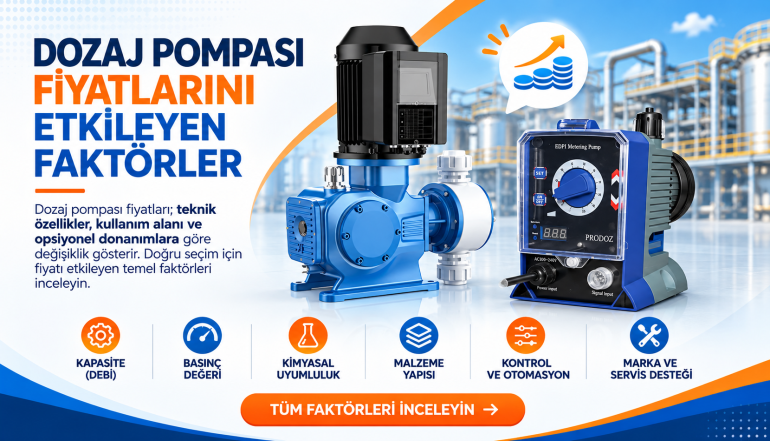
Factors Affecting Dosing Pump Prices
There may be a significant price difference between two quotes for a dosing pump designed to deliver 5 liters of chemical per hour. One quote might be for a pump with a manually adjusted, fixed-rate setting, while the other could be for a system that tracks variable water flow and transmits fault information to a control panel. When comparing dosing pump prices, three key details must first be clarified: at what pressure will the pump deliver the chemical, what type of fluid will it come into contact with, and who—or what device—will regulate the dosing rate? The answers to these questions reveal the functional value behind any price difference.
How do flow rate and operating pressure affect price?
Flow rate refers to the volume of liquid a pump delivers per unit of time, typically expressed in liters per hour (L/h) in most quotes. To calculate requirements accurately, it is essential to consider not only the total daily consumption but also the duration over which the dosing takes place. For instance, a system requiring 48 liters of solution per day, delivered evenly over 24 hours, needs a flow rate of 2 liters per hour. Conversely, a system that consumes the same amount over a six-hour production window requires a flow rate of 8 liters per hour. Thus, even with identical daily consumption, two different operations might receive quotes for pumps with entirely different capacities.
Pressure specifications must also be evaluated in conjunction with flow rate. The maximum flow rate and maximum pressure listed in a product catalog may correspond to different models within the same product family. A quote should clearly state that the selected model is capable of delivering the required flow rate while overcoming both the operating pressure at the injection point and any pressure losses within the discharge line. Furthermore, if dosing must continue during periods of reduced production, the minimum flow rate that the pump can reliably maintain also becomes a critical factor. The value gained from the additional cost of a wide adjustment range is particularly evident during these shifts.
Why are the components that come into contact with chemicals examined separately?
When selecting materials for a dosing pump, the pump head, diaphragm, valve balls, and seals are evaluated collectively. The suitability of the pump head material does not, by itself, guarantee that the seals within the valves will be resistant to the same chemical. When requesting a quote, providing the commercial name of the solution, its concentration, and the operating temperature helps the supplier recommend the correct combination of materials. The fact that the same model is offered with various pump head and seal options is one of the reasons for the price differences seen in a price list.
In which applications is automatic control beneficial?
On a production line operating at a constant speed, a flow rate setting made by an operator at the start of a shift may be sufficient. However, on a line where water consumption fluctuates throughout the day, a fixed setting will alter the amount of chemical dosed per unit volume of water. A dosing pump that operates by counting pulses from a flow meter can—when configured correctly—ensure that the chemical feed remains proportional to water consumption. In this scenario, a key feature influencing the price is the pump’s ability to accept a pulse input compatible with the flow meter’s output.
In a pH control application, the scope of a proposal may be broader. The measurement electrode, the controller, and the control signal input for the pump are all distinct components. If a suitable controller is already present at the facility, only a pump model compatible with that controller’s output may be required. For a new installation, the budget must also account for the necessary measurement and control equipment. Clarifying this distinction from the outset helps explain why two different suppliers might provide different total costs for the same application.
Which accessories and services are included in the proposal?
When comparing proposals for dosing pumps, it is advisable to request a written breakdown of the scope of supply from each company. One offer might include the suction hose, foot valve, and injection valve alongside the pump, while another might price these items separately. If a tank, mixer, control panel, or on-site commissioning is required, listing these as separate line items makes comparison much easier. When replacing an existing pump, checking the dimensions and materials of the current connections will help determine which accessories need to be purchased again.
How do you compare purchase price with operating costs?
In a wastewater treatment plant, if a dosing line operates daily, the lead time for a service kit is just as important as its price. Before making a purchase, you should inquire about the cost of the diaphragm and valve set for the chosen model, the recommended maintenance interval, and the availability (lead time) of spare parts. When evaluating a peristaltic model, the primary factor in this calculation is the hose that comes into contact with the fluid. By considering this information alongside annual operating hours, an organization can incorporate long-term costs—beyond the initial quote—into its budget.
During the decision-making phase, compare proposals side-by-side based on the same operating point, the same chemical, and the same scope of supply. This allows you to determine which portion of a price difference stems from material durability, automation requirements, or specific accessories and installation components. Providing these details when requesting a quote from Sisdoz for your application ensures that the proposed model and equipment are accurately tailored to your specific needs.