- sisdoz@sisdoz.com.tr
- TR

Blog
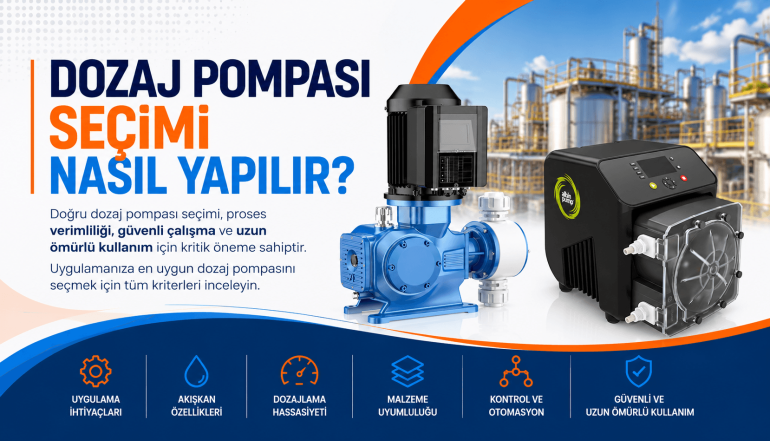
How to Select a Dosing Pump?
Selecting a dosing pump involves considering the properties of the fluid to be transferred, the required flow rate, the operating pressure, and the process's control requirements. Looking solely at the pump's capacity is insufficient for making the right choice. Factors such as chemical compatibility, dosing precision, suction conditions, and automation options must also be evaluated.
In industrial processes, a correctly selected dosing pump ensures that chemicals are delivered to the system in precise quantities and at a consistent rate. Conversely, an incorrect choice can lead to excessive chemical consumption, fluctuations in process parameters, frequent pump failures, or production disruptions.
What Is a Dosing Pump?
A dosing pump is a type of pump designed to transfer a specific quantity of fluid into a system in a controlled and repeatable manner. These pumps are primarily used to feed precise amounts of chemicals, disinfectants, additives, acids, and bases.
Dosing pumps are utilized across a wide range of sectors, from water treatment plants and the chemical industry to food production and energy facilities. Depending on the specific application, models with fixed flow rates, manual adjustments, sensor controls, or the capability to communicate with automation systems may be selected.
Where Should One Start When Selecting a Dosing Pump?
The selection process should begin not by comparing pump models, but by gathering the necessary information about the process. This is because two pumps with the same flow rate can differ significantly in terms of pressure, material composition, precision, and control features.
To select the right dosing pump, the following questions must first be answered:
- Which liquid is to be dosed?
- What is the concentration of the liquid?
- What quantity of chemical will be used per hour or per day?
- Into a line at what pressure will the chemical be injected?
- What are the liquid's temperature, density, and viscosity?
- Will the pump operate continuously or intermittently?
- Will the flow rate remain constant, or will it vary according to process parameters?
- Will the pump be controlled by a sensor or an automation system?
Once this information is clarified, the appropriate pump type and technical specifications can be determined more accurately.
How Is the Required Flow Rate Determined?
Flow rate refers to the volume of liquid a dosing pump transfers within a specific timeframe. Dosing pump capacity is typically expressed in liters per hour or milliliters per hour. When selecting a pump, the actual amount of chemical required for the process must be calculated.
A basic calculation can be performed as follows:
Required pump flow rate = Total amount of chemical to be used / Pump operating time
For example, if a process requires 80 liters of chemical per day and the pump is scheduled to operate for 10 hours daily, the average required flow rate would be 8 liters per hour.
However, operating the pump continuously at maximum capacity is not ideal. An appropriate operating range should be maintained to allow for process variations and capacity adjustments. Conversely, selecting a pump that is excessively large is also incorrect. High-capacity dosing pumps may fail to deliver the desired precision and stability when operated at very low settings.
How Should Pump Pressure Be Selected?
The pressure capacity of the dosing pump must exceed the actual backpressure in the line where the chemical is to be injected. Otherwise, the pump may fail to deliver the fluid into the system or may not achieve the flow rate specified in the catalog.
When determining system pressure, one should not consider only the nominal pressure of the production line. The following factors can also influence the total pressure:
- Length of suction and discharge lines
- Internal pipe diameter
- Elevation difference
- Elbows and fittings in the line
- Valves and injection equipment
- Fluid viscosity
- Instantaneous pressure fluctuations at the injection point
Having a pump with an excessively high pressure capacity is not always advantageous. Flow rate and pressure values should be selected within a range that suits the process requirements.
Why Is the Chemical to Be Dosed Important?
All parts of the dosing pump that come into contact with the liquid must be resistant to the chemical to be used. The pump head, diaphragm, valves, gaskets, hoses, and fittings should be selected according to the nature of the chemical.
Depending on the application, different materials such as PP, PVC, PVDF, PTFE, and stainless steel can be used. However, just because a material is resistant to a particular chemical does not mean that it will be suitable at all concentrations and temperatures.
Therefore, not only the name of the chemical but also the following information should be shared during the selection process:
- Concentration of the chemical
- Operating temperature
- Density
- Viscosity
- Whether it contains solid particles
- Tendency to form gas
- Possibility of crystallization or precipitation
Incorrect material selection may cause pump parts to wear or deform in a short time. Chemical leaks can pose a serious risk to both equipment and occupational safety.
How Does Fluid Viscosity Affect Pump Selection?
Viscosity refers to a fluid's resistance to flow. While chemicals with fluidity similar to water are easily transferred using standard dosing pumps, viscous liquids require special consideration.
High-viscosity products can reduce a pump's suction performance. Valve operation may become difficult, and the actual flow rate may fall below the capacity specified in the catalog. Such applications may require larger-diameter piping, alternative valve systems, or pump heads specifically designed for viscous fluids.
Keeping the suction line as short as possible also offers a significant advantage when handling high-viscosity fluids.
Which Type of Dosing Pump Should Be Chosen?
Dosing pumps operate based on various principles. When selecting a pump type, factors such as flow rate, pressure, precision, and the chemical properties of the fluid must be evaluated together.
Electromagnetic Diaphragm Dosing Pumps
Electromagnetic diaphragm pumps are widely used in low- to medium-flow applications. Thanks to their compact design and adjustable operating parameters, they are often preferred for water treatment, disinfection, and chemical conditioning processes.
Motor-Driven Diaphragm Dosing Pumps
Motor-driven diaphragm dosing pumps are suitable for industrial processes requiring higher capacities or continuous operation. The pump's motor power, diaphragm material, and operating range should be selected based on the specific application.
Piston Dosing Pumps
Piston pumps are a viable option, particularly for systems requiring high pressure. However, careful attention must be paid to the chemical compatibility of the wetted sealing components and maintenance requirements.
Peristaltic Dosing Pumps
In peristaltic pumps, the fluid comes into contact only with the inner surface of the tubing. This feature can offer advantages for liquids that release gas, contain particles, or possess distinct chemical properties. Hose material and replacement frequency should be taken into account when calculating operating costs.
How Is Dosing Precision Determined?
The required precision should be determined based on the application's tolerances. While minor flow rate variations may not pose a significant problem in some processes, even slight deviations can affect the outcome in applications such as pH adjustment, disinfection, recipe-based production, and laboratory work.
When selecting a pump, one must examine not only the maximum capacity but also the minimum operating flow rate, adjustment range, and repeatability performance. It is also important to evaluate whether the pump maintains consistent dosing stability under varying pressure conditions.
For systems requiring precise dosing, it is crucial to calibrate the pump under actual operating conditions, as catalog specifications are typically based on specific temperature, pressure, and reference fluid conditions.
What Is the Difference Between Manual and Automatic Dosing Pumps?
With manual dosing pumps, the capacity is set by the user, and the pump operates at the specified value. Manual control may suffice for applications where process conditions remain relatively stable.
Automatic dosing pumps, on the other hand, can adjust their flow rate based on signals received from external devices or sensors. They can operate in conjunction with equipment such as flow meters, counters, pH sensors, ORP sensors, conductivity sensors, or PLCs.
Automatic control is particularly beneficial in the following applications:
- Systems with constantly fluctuating water flow rates
- Processes requiring chemical dosing based on pH levels
- Applications where consumption is monitored via meters
- Production facilities managed by central automation systems
- Systems requiring remote monitoring and alarms
If a transition to automation is planned for the future, the pump's connectivity and communication capabilities should be evaluated during the purchasing stage.
What Are the Requirements for Suction and Installation?
For a dosing pump to operate correctly, both its technical specifications and the installation conditions must be suitable. Factors such as long suction lines, high suction lift, incorrect pipe diameters, and air trapped in the line can impair pump performance.
Whenever possible, the pump should be positioned close to the chemical tank, and the suction line should be kept short. Hose or pipe connections must be free of points that could allow air ingress.
Standard pump heads may be prone to air locking when handling off-gassing chemicals. In such cases, models featuring automatic air venting or application-specific suction arrangements are preferable.
How Should Auxiliary Equipment Be Selected?
Safe and stable operation of the dosing system may require certain auxiliary equipment alongside the pump. The equipment to be used is determined based on the facility's pressure, piping layout, and control requirements.
Commonly used auxiliary equipment in dosing systems includes:
- Suction filter
- Injection valve
- Back-pressure valve
- Pressure relief valve
- Pulsation dampener
- Calibration column
- Flow sensor
- Level switch
- Chemical tank and mixer
For instance, in applications with fluctuating line pressure, a back-pressure valve can help maintain dosing stability. A pressure relief valve, on the other hand, can be used to protect the pump and connecting equipment against excessive pressure in the line.
Consider the Operating Environment
Factors such as ambient temperature, humidity, dust levels, and ventilation conditions at the installation site must be taken into account. Dosing pumps operating outdoors may require protection against rain, sunlight, and temperature fluctuations.
Standard electrical equipment should not be used in areas where flammable or explosive gases may be present. In such facilities, motors, electrical connections, and pump models compliant with the area's safety classification must be selected.
Additionally, measures such as protective enclosures against chemical splashes, leak containment trays, and adequate ventilation should be included in the installation plan.
Evaluate Energy Consumption and Maintenance Costs
Relying solely on the purchase price when selecting a dosing pump can be misleading. The pump's energy consumption, maintenance frequency, and the costs of consumables and spare parts directly impact total operating expenses.
The following aspects should be investigated when selecting a pump:
- Replacement intervals for diaphragms, seals, valves, and hoses
- Availability of spare parts
- Ease of maintenance
- Technical service support
- Estimated service life of the pump
- Calibration and control requirements
A low-cost pump that is unsuitable for the application may result in higher long-term costs due to frequent breakdowns and production losses.
Common Mistakes in Dosing Pump Selection
Certain errors made during the selection of a dosing pump can lead to inefficient system operation. The most common mistakes include:
- Selecting a pump based solely on its maximum flow rate
- Failing to calculate system pressure
- Disregarding chemical concentration
- Not checking the chemical compatibility of pump materials
- Choosing an oversized pump
- Designing an excessively long suction line
- Ignoring viscosity and temperature values
- Considering automation requirements as an afterthought
- Omitting auxiliary equipment from the system plan
- Failing to research technical service and spare parts support
Quick Checklist for Dosing Pump Selection
Clarifying the following information before purchasing a dosing pump facilitates the selection process:
- Chemical name and concentration
- Required minimum and maximum flow rates
- Operating pressure
- Liquid temperature
- Density and viscosity
- Daily operating time
- Suction lift and line length
- Manual or automatic control preference
- Power supply specifications
- Installation environment conditions
- Required auxiliary equipment
- Maintenance and spare parts requirements
Frequently Asked Questions
How Is Dosing Pump Capacity Calculated?
The required capacity is calculated based on the total amount of chemical that must be injected into the system within a specific timeframe. An approximate hourly flow rate can be determined by dividing the daily chemical requirement by the pump's daily operating time. System pressure and fluid properties must also be considered for the final selection.
How Is Dosing Pump Pressure Determined?
Pump pressure is selected based on the actual operating pressure of the line where the chemical will be injected. The pump's pressure capacity must exceed the system's backpressure and allow for an adequate operating margin to account for line losses.
Can Any Dosing Pump Be Used With Any Chemical?
No. The pump components in contact with the fluid must be resistant to the specific chemical, its concentration, and the operating temperature. Selecting a pump without verifying chemical compatibility increases the risk of leakage and premature wear.
Should a Diaphragm or Piston Dosing Pump Be Chosen?
This decision should be based on flow rate, pressure, chemical properties, and sealing requirements. While diaphragm models are widely used for chemical dosing applications, piston models may be preferred for certain processes requiring high pressure.
Can a Dosing Pump Be Operated Automatically?
Dosing pumps with the appropriate specifications can be controlled automatically via flow meters, counters, pH sensors, ORP sensors, or a PLC. To achieve this, the pump must possess the necessary signal inputs and communication capabilities.
The Importance of Selecting the Right Dosing Pump
When selecting a dosing pump, factors such as flow rate, pressure, chemical compatibility, fluid properties, dosing precision, and automation requirements must be evaluated together. A high pump capacity does not, in itself, guarantee the right choice. The crucial factor is the pump's ability to operate safely, reliably, and efficiently under actual working conditions.
Accurately determining process specifications facilitates the selection of the right model from among suitable dosing pumps. This makes it possible to keep chemical consumption under control, reduce maintenance requirements, and ensure the system operates stably over the long term.