- sisdoz@sisdoz.com.tr
- TR

Blog
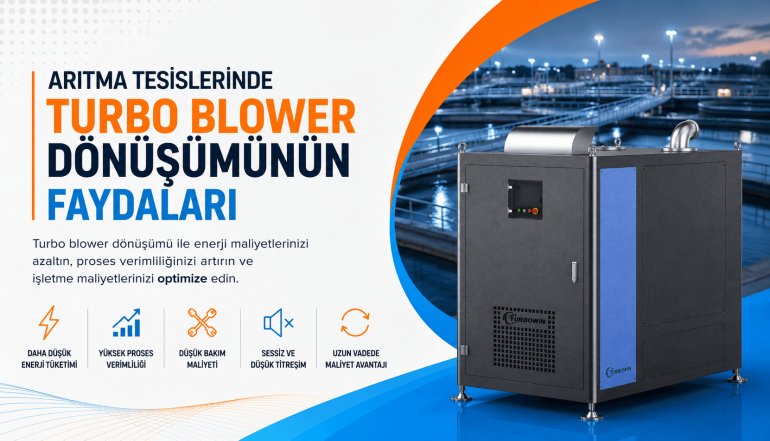
Benefits of Turbo Blower Conversion in Wastewater Treatment Plants
In wastewater treatment plants, a significant portion of energy consumption comes from aeration systems. Blower systems, which provide the oxygen required by microorganisms during biological treatment processes, are among the equipment that operates continuously throughout the day. Therefore, improvements in blower technology can directly affect operating costs.
In recent years, many facilities have been switching from traditional blower systems to turbo blower technology, which can offer higher efficiency. Turbo blower conversion not only supports energy savings but can also reduce maintenance costs, improve process control, and contribute to a facility’s sustainability goals.
In this article, we examine the main benefits of turbo blower conversion in wastewater treatment plants and the key factors that should be considered during the conversion process.
What Is a Turbo Blower?
A turbo blower is a modern air-generation technology that uses a high-speed motor, an advanced aerodynamic impeller design, and intelligent control systems to produce airflow efficiently.
Compared with traditional Roots blower systems, turbo blowers can offer the following advantages:
- Lower energy consumption
- Rapid adaptation to variable air demand
- Quieter operation
- Lower maintenance requirements
- Continuous operation at high efficiency
Turbo blower technology can provide significant operational advantages, particularly in facilities where energy costs represent a major portion of total operating expenses.
Why Is Aeration Important in Wastewater Treatment Plants?
Microorganisms involved in biological wastewater treatment require a continuous supply of oxygen to break down organic matter. This oxygen is delivered to aeration tanks through blower systems.
An insufficient air supply can lead to several operational problems, including:
- Reduced treatment performance
- Deterioration in effluent water quality
- Odor formation
- Increased energy consumption
- Disruption of process stability
For this reason, blower systems must operate at the correct capacity and deliver the required airflow as precisely as possible.
Advantages of Turbo Blower Conversion in Wastewater Treatment Plants
1. Reduced Energy Consumption
One of the most important benefits of turbo blower conversion is improved energy efficiency. Mechanical losses commonly associated with traditional blower systems can be significantly reduced through modern turbo blower technology.
This difference can have a direct impact on annual energy costs, especially in wastewater treatment plants that operate continuously.
Reduced energy consumption can provide several benefits:
- Lower operating costs
- Reduced carbon footprint
- Support for energy-efficiency targets
2. Rapid Adaptation to Variable Air Demand
Oxygen demand in wastewater treatment plants can change continuously throughout the day depending on influent load, process conditions, and treatment requirements.
Thanks to advanced speed and frequency control systems, turbo blowers can adjust airflow according to real-time demand.
This can help:
- Prevent unnecessary energy consumption
- Maintain more stable dissolved oxygen levels
- Improve overall process control
3. Lower Maintenance Costs
Turbo blower systems generally contain fewer moving mechanical components than conventional blower technologies. This can reduce maintenance requirements and simplify routine service operations.
As a result, turbo blower conversion may contribute to:
- Reduced unplanned downtime
- Shorter maintenance periods
- Lower operating and service costs
Regular preventive maintenance remains necessary, but maintenance intervals may be longer in many applications depending on operating conditions and the selected technology.
4. Quieter Operation
High noise levels in blower rooms can create a significant occupational comfort and safety issue for wastewater treatment facilities.
Because turbo blower technology can operate with lower vibration and reduced sound levels, it may provide the following advantages:
- Improved personnel comfort
- Reduced occupational safety risks related to noise exposure
- Lower need for additional sound insulation
5. Improved Process Performance
Turbo blower systems can provide more precise airflow control than many conventional systems.
More accurate airflow management can:
- Improve aeration efficiency
- Support more stable microorganism activity
- Help maintain treatment quality
- Make effluent parameters easier to control
Which Facilities Are Suitable for Turbo Blower Conversion?
Turbo blower conversion can provide high efficiency and operational benefits in a wide range of wastewater treatment applications, including:
- Municipal wastewater treatment plants
- Organized industrial zone treatment plants
- Food industry wastewater treatment plants
- Chemical industry treatment facilities
- Textile factory wastewater treatment systems
- Large-scale industrial wastewater treatment plants
However, the most suitable blower technology should be selected according to engineering calculations, operating conditions, airflow requirements, and system pressure values.
What Should Be Considered During Turbo Blower Conversion?
For a successful conversion project, simply replacing the existing blower is not sufficient. The entire aeration system should be evaluated as part of an integrated engineering study.
Existing System Analysis
The performance, operating hours, airflow capacity, pressure values, and energy consumption of the existing blower system should be measured and recorded.
Airflow Requirement
The minimum, average, and maximum airflow requirements of the treatment plant should be calculated accurately. The selected turbo blower should be capable of responding efficiently to changing process demands.
Pressure Requirements
Pressure losses caused by diffusers, pipelines, valves, fittings, and other system components should be analyzed before blower selection.
Automation Compatibility
The new turbo blower system should be compatible with the facility’s existing SCADA, process control, and automation infrastructure.
Investment Payback Period
The expected payback period should be calculated by considering energy savings, maintenance costs, operating hours, equipment efficiency, and the initial investment amount.
What Benefits Does Turbo Blower Conversion Provide to Businesses?
A properly designed turbo blower conversion project can provide significant long-term operational and financial advantages.
The main benefits include:
- Lower energy costs
- Higher process efficiency
- More stable oxygen control
- Reduced maintenance expenses
- Lower noise levels
- Longer equipment service life
- Reduced carbon emissions
- More sustainable plant management
Frequently Asked Questions
Does turbo blower conversion save energy?
Yes. With proper engineering, correct capacity selection, and suitable operating conditions, turbo blower systems can provide significant energy savings compared with traditional blower technologies.
Is a turbo blower suitable for every wastewater treatment plant?
Not necessarily. Each facility has different airflow requirements, pressure values, operating conditions, and process characteristics. Therefore, the most suitable blower technology should be determined through a detailed engineering analysis.
Does a turbo blower require maintenance?
Yes. Like all industrial equipment, turbo blowers require regular inspection and preventive maintenance. However, maintenance requirements may be lower than those of conventional blower systems, depending on the technology and operating environment.
What is the payback period for turbo blower conversion?
The payback period varies depending on the facility’s operating hours, electricity costs, existing blower efficiency, airflow demand, and investment cost. In many projects, energy savings can allow the investment to pay for itself within a few years.
Conclusion
Turbo blower conversion in wastewater treatment plants is not simply an equipment replacement. It is a strategic investment that can improve energy efficiency, process performance, operational reliability, and sustainable plant management.
Considering the substantial share of aeration systems in overall energy consumption, modern turbo blower technologies can provide significant benefits to wastewater treatment facilities.
To achieve maximum efficiency from the conversion process, the existing system should be analyzed in detail, the correct blower capacity should be selected, and engineering solutions should be designed according to the facility’s actual operating requirements.
A properly planned turbo blower conversion can reduce long-term operating costs, improve process efficiency, and enhance the overall performance of wastewater treatment plants.