- sisdoz@sisdoz.com.tr
- TR

Blog
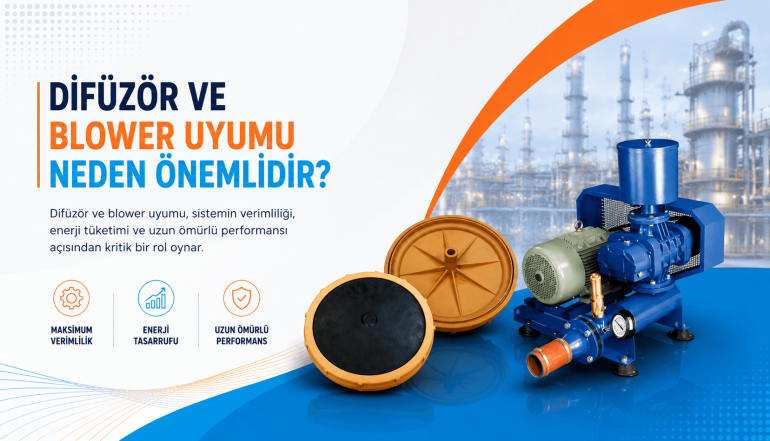
Why is Diffuser and Blower Compatibility Important?
Diffuser and blower systems used in wastewater treatment plants, fish farms, industrial processes, and various aeration applications are among the fundamental components of process efficiency. However, while equipment selections are evaluated separately in many projects, one of the most important issues directly affecting system performance is often overlooked: diffuser and blower compatibility.
No matter how powerful a blower is, it cannot provide the expected performance if it is not compatible with the diffuser system used. Similarly, a high-quality diffuser can cause a loss of efficiency if operated with a blower of the wrong capacity. Therefore, in aeration systems, equipment should be evaluated as a whole, not individually.
In this article, we will discuss in detail why diffuser and blower compatibility is critical, the problems that incorrect equipment pairings can cause, and the advantages of choosing the right system.
How Do Diffuser and Blower Systems Work Together?
In aeration systems, the blower produces the necessary air and transmits it under pressure through pipelines to the diffusers. The diffusers then distribute this air into a liquid medium in the form of numerous small bubbles. In this process:
- The blower creates the air flow.
- The pipeline carries the air.
- The diffuser distributes the air.
- Oxygen transfer takes place.
For the system to work efficiently, all components must be compatible with each other.
What Problems Does Diffuser and Blower Incompatibility Cause?
In many businesses, one of the main reasons for higher-than-expected energy consumption or lower aeration performance is equipment incompatibility.
In incorrectly selected systems:
- Insufficient oxygen transfer may occur.
- Energy costs may increase.
- The blower may operate under overload.
- Diffuser performance may decrease.
- Equipment lifespan may be shortened.
- Maintenance costs may increase.
Therefore, accurate engineering calculations during the project phase are of great importance.
Air Flow Rate and Diffuser Capacity Balance
Each diffuser is designed to operate with maximum efficiency within a specific air flow rate range.
If air is supplied above the diffuser capacity:
- Bubble sizes may increase,
- Oxygen transfer efficiency may decrease,
- The membrane structure may be damaged,
- Pressure losses may occur.
If air is supplied below the diffuser capacity, the system will not achieve the expected performance.
Therefore, the operating ranges of the diffusers must be taken into account when selecting a blower.
Why is Pressure Matching a Critical Factor?
When selecting a blower, attention should be paid not only to the amount of air but also to the pressure required by the system.
The total system pressure is determined by calculating:
- Water depth,
- Pipeline length,
- Elbow and valve losses,
- Diffuser resistances.
A blower that produces insufficient pressure cannot deliver enough air to the diffusers. Excessively high pressure can lead to energy loss and equipment wear.
Importance in Terms of Oxygen Transfer Efficiency
Especially in biological wastewater treatment plants, the main purpose of the system is to transfer oxygen, not air, to the water.
Thanks to the compatibility of the diffuser and blower:
- Smaller air bubbles are formed,
- The residence time of the bubbles in the water increases,
- The oxygen dissolution rate increases,
- Biological treatment performance improves.
This means both energy savings and a more efficient process.
How Does it Affect Energy Consumption?
Aeration systems constitute a significant portion of total energy consumption in many wastewater treatment plants.
An incorrectly matched blower and diffuser system can:
- Consume more energy than necessary,
- Operate at continuously high load,
- Increase operating costs.
In correctly designed systems, the blower only operates at the required capacity, preventing unnecessary energy losses.
The Relationship Between Diffuser Type and Blower Selection
Different diffuser types have different operating characteristics.
Fine Bubble Diffusers
- Provides high oxygen transfer efficiency.
- Requires more precise air distribution.
- Accurate pressure calculations are necessary.
Coarse Bubble Diffusers
- Create lower pressure losses.
- More resistant to clogging.
- Preferred in mixing applications.
Therefore, the blower technology and capacity should be determined according to the type of diffuser to be used.
Considerations During the Design Process
To ensure diffuser and blower compatibility, the following criteria should be evaluated together:
- Daily and maximum flow rate requirement
- Volume of the tank to be aerated
- Water depth
- Desired oxygen transfer amount
- Type and number of diffusers
- Pipeline length
- Future capacity increases
Equipment selections made without considering these parameters can lead to serious costs in the long run.
What Does the Correct Diffuser and Blower Matching Bring to the Operation?
A properly designed system:
- Provides lower energy consumption,
- Increases oxygen transfer efficiency,
- Improves purification performance,
- Reduces maintenance costs,
- Extends equipment life,
- Increases operational reliability.
These advantages create significant cost savings, especially in large-scale facilities.
Diffuser and blower systems are not independently operating equipment, but two fundamental components of the same system that complement each other. For the diffuser to use the air produced by the blower in the most efficient way, the flow rate, pressure, and system requirements must be correctly analyzed. Thanks to the correct equipment matching, energy costs can be reduced while oxygen transfer efficiency is increased, and plant performance can be made sustainable. Therefore, in new installations and existing system revisions, diffuser-blower compatibility must be evaluated with a professional engineering approach.