- sisdoz@sisdoz.com.tr
- TR

Blog
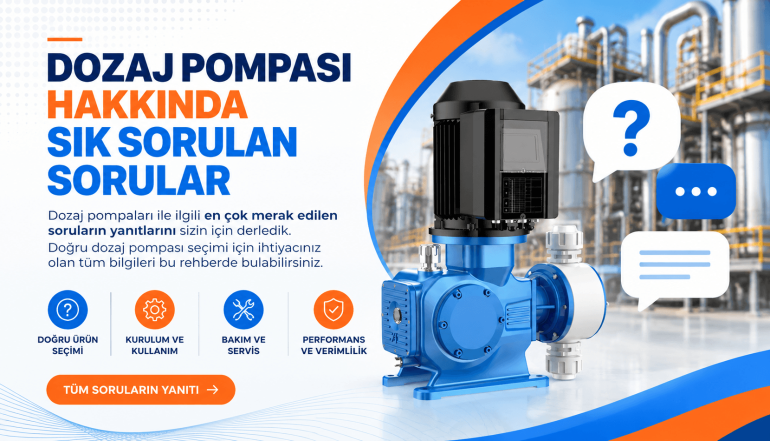
Frequently Asked Questions About Dosing Pumps
A dosing pump is a pump that delivers a specific, controlled amount of liquid into a process. It is used in operations such as chemical dosing for water treatment, the addition of additives during production, and pH adjustment. To achieve the desired result, factors such as fluid properties, line pressure, and operating conditions are just as important as the pump's capacity. Common questions regarding their use include how to make the correct settings, why a pump might fail to discharge fluid, and how to determine when maintenance is required.
What Is the Function of a Dosing Pump?
A dosing pump allows for the control of the quantity of liquid added to a system. For example, if the amount of chemical fed into a treatment line is insufficient, the intended process may be ineffective; conversely, an excessive amount can lead to increased consumption and disrupt the process balance. When operated with an appropriate control system, the pump helps adjust the feed rate according to specific requirements.
What Is the Difference Between a Dosing Pump and a Transfer Pump?
The primary function of a transfer pump is to move liquid from one point to another. In dosing applications, however, the ability to adjust and repeat the transferred quantity is crucial. Therefore, not just any pump capable of delivering the desired flow rate is suitable for precise chemical dosing. Selection criteria include the minimum feed rate, the adjustment range, and performance under varying operating conditions.
How Do Dosing Pumps Work?
Common diaphragm and piston models draw in liquid and discharge it into the delivery line by varying the volume of the pump chamber. Check valves ensure the flow moves in the correct direction. In peristaltic models, the liquid is transported by compressing a flexible hose. Since the operating principle varies by model, flow rate adjustment and maintenance procedures differ from one pump to another.
Which Liquids Can Be Dosed?
Acids, bases, disinfectants, coagulants, and various liquid additives can be dosed using appropriate equipment. However, the fact that a pump is manufactured for chemical applications does not mean it is compatible with all chemicals. Information regarding the liquid's name, concentration, temperature, viscosity, and—if applicable—solids content is required. The compatibility of the pump body, diaphragm, seals, valves, and connection components must also be verified.
Why Are Hourly Capacity and Pressure Evaluated Together?
Capacity refers to the volume of liquid a pump can deliver per unit of time under specific conditions; it is usually expressed in liters per hour. Pressure, on the other hand, determines the line conditions against which the pump must deliver the liquid. The maximum flow rate and maximum pressure values listed in a catalog are not necessarily achieved at the same operating point. Suitability must be verified against the specific model's performance data.
When evaluating dosing pump options with varying capacities and operating principles, it is essential to base decisions on the process's actual operating range rather than just the product's maximum specifications.
Does the Percentage Setting on the Pump Indicate the Actual Flow Rate?
The percentage setting does not always correspond directly to a specific liter-per-hour output across all models. Depending on the pump, it may refer to stroke length, stroke frequency, or drive speed. The actual delivery volume can be influenced by factors such as back pressure, suction conditions, and fluid properties. Therefore, one should not assume that a 50% setting will yield exactly half of the rated catalog capacity under all circumstances.
When Should a Dosing Pump Be Calibrated?
Calibration involves verifying the actual volume of liquid delivered over a specific period and adjusting the pump settings accordingly if necessary. It is advisable to perform this check during initial commissioning, after maintenance, or whenever there are changes in the chemicals used or the piping system. The frequency of recalibration is determined by the process's precision requirements and the manufacturer's instructions. Measurements should be taken using appropriate equipment and a setup that replicates actual operating conditions as closely as possible.
Why Does the Pump Fail to Deliver Liquid Even When Running?
Possible causes include an empty tank, air ingress in the suction line, a clogged filter, debris accumulation in the valve, or gas trapped in the pump head. Line pressure exceeding the pump's operating limit can also halt the feed. Motor noise or stroke movement alone does not prove that the chemical is actually reaching the line. During inspection, the tank level and visible connections should be checked first; any necessary interventions must be performed according to the manufacturer's instructions.
Does Increasing the Capacity Solve the Problem of a Pump Air-Locking?
If air or gas accumulation is present, simply increasing the capacity will not eliminate the root cause. Factors such as the seal integrity of suction connections, the tank level, and the gas-release tendency of the fluid should be evaluated. In appropriate applications, an air-venting arrangement or a pump head designed for such fluids may be selected. The venting process must be carried out in a way that prevents the uncontrolled release of the chemical into the open environment.
Can a Dosing Pump Be Run Dry?
Dry-running capability depends on the pump's design and the materials used. A specification applicable to one model cannot be generalized to another. Even if the manufacturer permits it, an empty tank results in the process being deprived of the chemical. Therefore, functions such as level alarms or low-level cut-offs are important not only for protecting the pump but also for monitoring the process.
Can the Chemical Feed Be Automatically Adjusted as the Flow Rate Changes?
In models equipped with suitable control inputs, the feed rate can be adjusted based on pulse signals from a flow meter or analog signals. Control linked to process measurements, such as pH, can also be implemented using appropriate sensors and controllers. However, the mere presence of a signal input on the pump is not sufficient on its own. The signal range, scaling, and behavior in the event of a fault must also be defined.
Can a Single Pump Be Used for Different Chemicals?
This decision cannot be made based solely on the pump material. Residual amounts of the previous chemical may react with the new one. When switching chemicals, factors such as material compatibility, the appropriate cleaning method, and the interaction between the chemicals must be evaluated together. Particularly in applications where different products are to be fed sequentially through the same line, the use of separate pumps and lines should be technically assessed.
How Can Maintenance Needs Be Determined?
A drop in feed rate at the same setting, irregular flow, leaks at connections, or frequent air-locking of the pump are signs that inspection is required. However, one should not wait for a breakdown to perform maintenance. Inspection intervals for components such as diaphragms, hoses, seals, and valves are determined by operating time, chemical properties, and manufacturer recommendations. It is not appropriate to specify a single maintenance schedule that applies to every facility.
What Factors Determine Dosing Pump Prices?
Flow rate and pressure range, wetted materials, drive system, control options, and required accessories influence the price. In addition to the initial purchase cost, the availability of spare parts and maintenance requirements should also be considered. A lower-priced model may prove more costly for the operation if it fails to provide the level of control the process requires.
What Information Should Be Provided When Requesting Technical Support?
The name and concentration of the chemical, desired minimum and maximum flow rates, line pressure, fluid temperature, and daily operating time are the essential details to start with. If there is an existing issue, the pump model, current settings, and the conditions under which the problem occurs should also be specified. With this information, dosing pumps and related system components can be evaluated more accurately, clarifying details that might otherwise be overlooked if selections were based solely on photographs or capacity specifications.