- sisdoz@sisdoz.com.tr
- TR

Blog
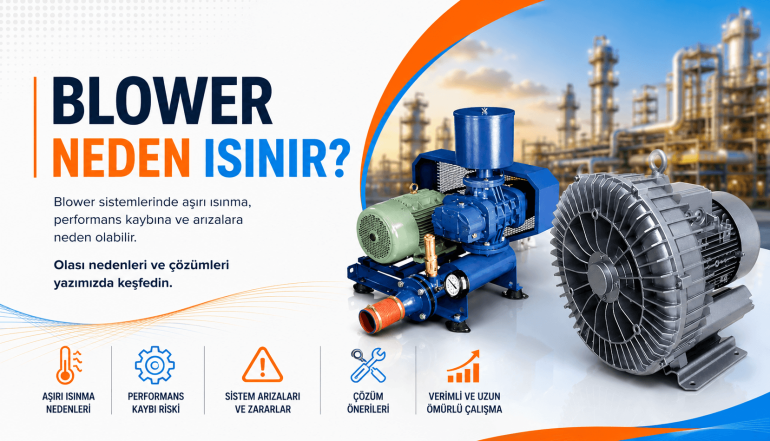
Why Does a Blower Get Hot? Possible Causes and Solutions
Blower systems used in industrial facilities naturally generate heat while bringing air to a certain flow rate and pressure level. Therefore, it is normal for the blower outlet air and its housing to heat up to a certain extent during operation. However, if the temperature exceeds the operating limits specified by the manufacturer, the temperature alarm is activated, or the blower device shuts down to protect itself, this indicates a problem in the system that needs to be investigated.
Blower overheating can be caused by various factors such as insufficient ventilation, dirty filters, high operating pressure, improper lubrication, mechanical wear, or incorrect capacity selection. Repeatedly operating the device without determining the source of the problem can lead to serious damage to important components such as bearings, seals, rotors, belts, and electric motors.
Why Does a Blower Generate Heat During Operation?
A blower draws air from the atmosphere through the suction line and delivers it to the system by creating a certain pressure difference. As the pressure of the air increases, its temperature also rises. In other words, the compression process performed by the blower naturally generates heat.
The main factors affecting blower operating temperature include:
- Intake air temperature
- Blower inlet and outlet pressure
- Total pressure difference
- Air flow rate
- Blower technology
- Motor speed
- Operating time
- Ambient ventilation conditions
- Resistance in filters and pipelines
Therefore, a blower being hot does not automatically indicate a malfunction. What matters is whether the temperature remains within the normal operating range. Since acceptable temperature levels vary depending on blower type, model, lubrication system, and operating conditions, the manufacturer's technical documentation should always be used as a reference.
What Are the Symptoms of Blower Overheating?
Overheating does not always appear only as a temperature alarm. Various changes in the operating characteristics of the equipment may occur before the problem becomes more serious.
Common symptoms of blower overheating include:
- Outlet air temperature rising above normal
- Excessive temperature around the housing or bearings
- Temperature alarm activation
- Frequent blower shutdowns
- Motor current exceeding normal values
- Burnt oil, rubber, or electrical odor
- Oil darkening or thickening rapidly
- Excessive vibration
- Friction, humming, or knocking noises
- Reduced air flow rate
- Increased energy consumption
- Cracking or deformation of belts
- Deterioration of seals and gaskets
If one or more of these symptoms are detected, the blower should not simply be restarted. Pressure, flow rate, temperature, motor current, and vibration values should be evaluated together to identify the actual cause of overheating.
Why Does a Blower Overheat?
A rise in blower temperature may not be caused by a single problem. In some cases, a dirty filter, insufficient ventilation, and high operating pressure may occur simultaneously. Therefore, the entire system should be examined during troubleshooting.
1. Dirty or Clogged Suction Filter
The suction filter prevents dust and foreign particles in the air from entering the blower. Over time, contamination can restrict airflow and increase resistance on the suction side.
When the blower is forced to operate under more demanding conditions to draw the required air:
- The pressure difference may increase.
- The airflow may decrease.
- The motor load may change.
- The operating temperature may rise.
- Energy consumption may increase.
A filter that looks clean from the outside may still restrict airflow. Whenever possible, filter condition should be evaluated by monitoring the pressure difference before and after the filter, rather than relying only on visual inspection.
Solution: The suction filter should be inspected at the maintenance intervals specified by the manufacturer, cleaned using an appropriate method, or replaced when necessary. In facilities with high dust levels, inspection intervals may need to be shorter than the standard maintenance schedule.
2. High Back Pressure in the Outlet Line
When a blower operates above its designed pressure range, the compression ratio and outlet temperature may increase.
Common causes of high back pressure include:
- Closed or partially closed valves
- Undersized pipelines
- Clogged diffusers
- Contaminated filters
- Deposits inside pipelines
- Crushed or damaged connections
- Excessive use of elbows
- Incorrect check valve selection
- Changes in process conditions
- Failure of the relief or safety valve
For example, fouling of diffusers in wastewater treatment plants can increase the pressure required to transfer air into the water. The blower then operates at a higher pressure to maintain the required airflow, which can increase operating temperature.
Solution: Blower outlet pressure should be checked using a pressure gauge or sensor. The measured value should be compared with the blower performance curve and permitted operating limits. Pipelines, valves, check valves, filters, and process equipment should also be inspected for blockages.
3. Inadequate Ventilation of the Blower Room
If the heat generated by the blower cannot be removed from the surrounding environment, the blower may continuously draw increasingly warm air. This is particularly common in enclosed or poorly ventilated blower rooms.
Signs of inadequate ventilation may include:
- Continuous increase in blower room temperature
- Hot exhaust air returning to the intake
- Insufficient ventilation fan capacity
- Blocked air inlet or outlet openings
- Equipment positioned too close together
- Cooling ducts clogged with dust
Higher intake air temperature directly affects blower discharge temperature. If a system begins to trigger temperature alarms during warmer periods, ambient ventilation may no longer be sufficient for the operating conditions.
Solution: Adequate clean and cool air should be supplied to the blower room, while hot air should be discharged outside through suitable ventilation ducts. Hot exhaust air should not be allowed to recirculate into the blower intake.
4. Contamination of Cooling Surfaces
Dust and oil deposits on the blower housing, motor, or cooling equipment can reduce heat transfer. In dusty industrial environments, contamination on external surfaces may act as an insulating layer.
In air-cooled systems, dirty fan blades and blocked cooling passages can also reduce cooling capacity.
Solution: The blower housing, motor fan, protective grilles, and cooling ducts should be cleaned regularly. Before maintenance, the equipment should be safely de-energized and the manufacturer's maintenance instructions should be followed.
5. Low Oil Level or Incorrect Lubricant
In lubricated blower models, oil plays an important role in protecting gears, bearings, and moving components. Low oil levels can increase friction and mechanical temperature.
Lubrication-related problems that may cause overheating include:
- Low oil level
- Excessive oil filling
- Incorrect oil viscosity
- Using lubricant not approved by the manufacturer
- Oil exceeding its service life
- Water or contamination entering the oil
- Blocked oil passages
- Oil leakage
Oil that darkens quickly or develops a burnt smell may be both a consequence of excessive heat and an indication of a lubrication problem.
Solution: Oil level should be checked when the blower is stopped and under the conditions specified by the manufacturer. Oil type, quantity, and replacement intervals should comply with manufacturer recommendations.
6. Bearing, Gear, or Rotor Wear
Bearing wear can increase friction and cause localized temperature increases. Misalignment, insufficient lubrication, severe operating conditions, or inadequate maintenance can shorten bearing life.
Mechanical wear may be accompanied by:
- High bearing temperature
- Increased vibration
- Humming or metallic noises
- Higher motor current
- Irregular operation
- Reduced airflow
In Roots blower systems, incorrect rotor timing or operating clearances can also result in friction and excessive heat.
Solution: Vibration, bearing temperature, and changes in operating noise should be monitored. Mechanical components should be inspected by trained or authorized technical personnel.
7. Incorrect Belt Tension
In belt-driven blower systems, belts that are too tight may place excessive loads on blower and motor bearings. Belts that are too loose can slip, creating friction and additional heat.
Worn, cracked, or misaligned belts may also reduce power transmission efficiency.
Solution: Belt tension, alignment, and physical condition should be inspected regularly. Adjustments should be made according to manufacturer specifications, and belt sets should be replaced together when required.
8. Incorrect Blower Capacity
A blower selected without correctly calculating the required flow rate and pressure may be forced to operate continuously near its limits. An undersized blower operating continuously at maximum speed can experience excessive temperature problems.
An oversized blower is not necessarily a safer solution. Improper control, frequent starting and stopping, or operation outside the efficient range may also increase energy consumption and mechanical stress.
Solution: Actual operating flow rate and pressure should be measured, and the operating point should be checked against the blower performance curve. If process demand varies, a suitable control system or frequency converter may be required.
9. Incorrect Operating Speed
Increasing blower speed beyond the manufacturer's limits may increase airflow, but it can also raise motor load, noise, and operating temperature.
In systems equipped with a frequency converter, both maximum and minimum operating speeds are important. At very low speeds, motors that depend on shaft-mounted cooling fans may not receive sufficient cooling.
Solution: Frequency and speed settings should remain within the approved operating range of both the blower and motor. If system capacity is increased later, motor power, blower speed, and discharge temperature should be evaluated together.
10. Electric Motor Problems
In some cases, the component overheating is the blower motor rather than the blower itself.
Common causes of excessive motor temperature include:
- Phase imbalance
- Low or high supply voltage
- Loose electrical connections
- Overcurrent
- Motor cooling fan failure
- Incorrect star-delta connection
- Frequent starting and stopping
- Insufficient motor power
- Bearing failure
- Excessive electrical panel temperature
Solution: Voltage and current values for each phase should be measured by qualified electrical personnel. Actual operating values should be compared with motor nameplate specifications, and thermal protection, sensors, and cooling fans should be inspected.
11. Frequent Starting and Stopping
Frequent starting and stopping can place additional stress on the blower motor and mechanical components. Each start requires high motor current, and if the system restarts before it has sufficiently cooled, temperature may increase over time.
This issue is commonly associated with incorrect automation settings, a narrow control range, incorrect sensor positioning, or capacity mismatch.
Solution: Starting and stopping frequency should be monitored, and automation parameters should be adjusted according to process requirements. The maximum number of starts specified by the manufacturer should not be exceeded.
12. Incorrect Installation or Rotation Direction
Incorrect motor rotation after electrical connection can disrupt airflow and cause mechanical problems in some blower types. Improper piping connections, insufficient flexible connectors, uneven foundations, or coupling misalignment may also cause excessive vibration and temperature.
Solution: Before initial startup, rotation direction, piping connections, coupling alignment, foundation condition, and pipeline loads should be checked. Pipeline weight should not be transferred directly to blower connection points.
Blower Overheating Causes and Solutions Summary
| Possible Cause | Common Symptom | Things to Check |
|---|---|---|
| Dirty suction filter | Reduced airflow, increased temperature | Filter condition and pressure loss |
| High back pressure | Higher motor current and outlet temperature | Valves, pipelines, check valves, and diffusers |
| Insufficient ventilation | Heat buildup in the blower room | Fans, vents, and air circulation |
| Lubrication problem | Burnt oil smell, high bearing temperature | Oil level, type, quality, and leakage |
| Bearing wear | Vibration and abnormal noise | Bearing temperature and vibration levels |
| Incorrect belt adjustment | Belt slipping or overheating | Tension, wear, and alignment |
| Excessive speed or load | High current and frequent alarms | Frequency, motor current, and operating point |
| Motor problem | Excessive motor housing temperature | Phases, voltage, current, and motor fan |
| Dirty cooling surfaces | Insufficient heat dissipation | Fans, grilles, housing, and coolers |
| Incorrect capacity selection | Continuous operation near limits | Actual airflow, pressure, and performance curve |
What Should You Do When a Blower Overheats?
When a blower triggers a temperature alarm or becomes unusually hot, the following steps can be taken:
- Stop the blower in a controlled manner.
- Safely disconnect the power supply.
- Do not open maintenance covers until the blower has cooled sufficiently.
- Record alarm and fault history from the control panel.
- Inspect the suction filter and air inlets.
- Check the position of outlet valves.
- Compare pressure and motor current values.
- For lubricated models, inspect the oil level and condition.
- Check belts, couplings, fans, and connections.
- If abnormal vibration or noise is present, do not restart the equipment.
Simply resetting the alarm and restarting the blower does not solve the underlying problem. Unless the cause of overheating is identified, the temperature may rise again and lead to more serious damage.
How to Monitor Blower Temperature?
A single temperature measurement point may not provide enough information. Depending on the system design, the following parameters can be monitored:
- Suction air temperature
- Discharge air temperature
- Blower housing temperature
- Bearing temperatures
- Oil temperature
- Motor winding or housing temperature
- Blower room ambient temperature
Outlet pressure, airflow, motor current, and vibration should also be recorded together with temperature values. This helps identify the operating conditions under which temperature increases occur.
Maintaining regular operating records instead of relying on one-time measurements can help identify performance changes before they reach alarm levels.
How Can Blower Overheating Be Prevented?
The most effective way to prevent blower overheating is to combine regular maintenance with continuous monitoring of operating data.
Recommended preventive measures include:
- Regularly inspecting suction filters
- Improving blower room ventilation
- Preventing hot exhaust air from returning to the intake
- Continuously monitoring outlet pressure
- Removing pipeline blockages
- Maintaining diffusers and process equipment
- Checking oil level and quality
- Monitoring motor current
- Inspecting belt and coupling alignment
- Monitoring bearing temperature and vibration
- Keeping blower surfaces and cooling ducts clean
- Testing sensors and safety equipment regularly
- Operating the blower within the correct region of its performance curve
- Following manufacturer maintenance intervals
Maintenance intervals should not be based only on operating hours. Dusty environments, high ambient temperatures, continuous operation, and variable process loads may require more frequent maintenance.
Does High Blower Temperature Affect Energy Consumption?
Yes. Excessive temperature can indicate that the blower is operating outside its most efficient range. A blower working against a dirty filter, undersized pipeline, or excessive back pressure may require more energy to deliver the necessary airflow.
Higher blower temperatures may be accompanied by:
- Increased motor current
- Reduced airflow
- Longer operating periods
- Shorter oil and filter life
- Increased mechanical losses
- More frequent unplanned shutdowns
For this reason, monitoring blower temperature is important not only for equipment protection but also for maintaining energy efficiency.
Do Overheating Causes Vary by Blower Type?
The operating principle of the blower affects the types of overheating problems that may occur.
Roots blowers should be checked for excessive pressure differential, clogged outlet lines, suction filter resistance, incorrect belt adjustment, gear oil condition, and rotor timing.
Screw blowers may also require inspection of the lubrication system, cooling system, oil filters, thermostatic elements, and coolers.
Turbo blowers require particular attention to suction filters, ambient conditions, cooling systems, control software, and whether the operating point remains within the stable operating range.
Side channel blowers may overheat because of clogged suction or outlet lines, excessive pressure difference, insufficient airflow, or high ambient temperature.
Therefore, troubleshooting should include both general system checks and maintenance procedures specific to the blower technology being used.
Frequently Asked Questions
Is it normal for a blower to get hot?
Yes. Heat is generated during air pressurization, so a certain increase in blower housing and discharge air temperature is normal. However, if the temperature exceeds manufacturer limits or triggers an alarm, the system should be inspected.
Why does a blower discharge hot air?
A blower increases air temperature as it raises pressure. Discharge temperature depends on intake temperature, pressure difference, blower type, and operating conditions. Excessively hot discharge air may indicate high back pressure or insufficient cooling.
Can a dirty filter increase blower temperature?
Yes. A dirty suction filter restricts airflow and can increase pressure difference, energy consumption, and operating temperature. Filter condition and pressure loss should be monitored regularly.
Can low oil level cause a blower to overheat?
Yes. In lubricated blower models, low oil levels can increase friction in bearings and gears, causing excessive heat. The cause of oil loss should be identified, and only lubricant meeting manufacturer specifications should be used.
Why does a blower keep tripping the thermal protection?
High motor current, phase imbalance, insufficient cooling, excessive back pressure, frequent starting, or mechanical jamming may cause thermal protection to trip. Electrical and mechanical operating values should be evaluated together.
Can a blower operate with the outlet valve closed?
Most blower systems should not be operated against a closed outlet valve. This can cause a rapid increase in pressure and temperature. Manufacturer operating and commissioning instructions should always be followed.
Can a blower temperature alarm simply be reset?
Repeatedly restarting the equipment without identifying the cause of the alarm is not recommended. Filters, ventilation, pressure, lubrication, motor current, and mechanical components should be checked first.
Conclusion
Although a certain amount of heat generation is normal in blower systems, uncontrolled temperature increase is an important warning sign. Dirty suction filters, high back pressure, insufficient ventilation, lubrication problems, mechanical wear, incorrect speed settings, and incorrect blower sizing are among the most common causes of overheating.
Temperature should not be evaluated alone when diagnosing the problem. Blower outlet pressure, airflow, motor current, vibration, ambient temperature, and maintenance history should all be reviewed together.
Regular filter inspections, proper lubrication, adequate ventilation, and monitoring the operating point through the blower performance curve help ensure safer, more efficient, and longer-lasting blower operation. If temperature alarms continue to occur, the equipment should be inspected by qualified technical service personnel instead of being repeatedly restarted.